


Key Takeaways
- Tesla and SpaceX launched a $25 billion chip fabrication facility called “Terafab” in Austin, Texas, aiming for unprecedented computing power.
- The facility plans to produce advanced 2-nanometer chips for AI applications, while also targeting a significant portion of the global semiconductor market.
- Musk envisions 80% of Terafab’s output will support space-based applications, raising questions about the feasibility and timing of the ambitious project.
Ambitious Vision: Terafab Unveiled
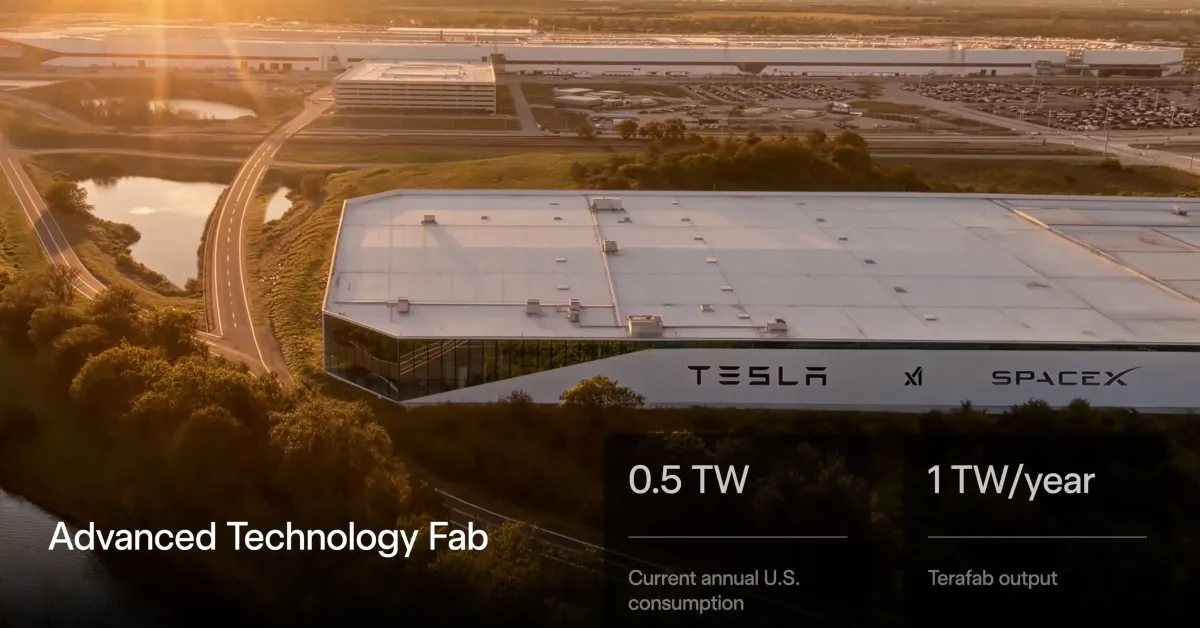
Tesla and SpaceX have announced a groundbreaking venture named “Terafab,” a $25 billion semiconductor fabrication facility situated in Austin, Texas. Elon Musk dubbed this project “the most epic chip building exercise in history,” claiming it will generate an astonishing 1 terawatt of computing power each year.
The Terafab initiative is a collaborative effort involving Tesla, SpaceX, and xAI—an AI company recently acquired by SpaceX. Planned for the North Campus of Giga Texas, Terafab aims to consolidate all semiconductor production stages, including chip design, lithography, fabrication, memory production, advanced packaging, and testing, under one roof.
Tesla’s ambitions for the facility are lofty. The project is set to initiate with a production capacity of 100,000 wafer starts per month, with a goal of scaling up to 1 million wafer starts monthly at full capacity. This final target would account for 70% of TSMC’s current total global output, marking an unprecedented achievement for a facility managed by operators without previous chip fabrication experience.
Musk outlined plans for the facility to manufacture between 100 and 200 billion custom AI and memory chips annually, which would support Tesla’s “Full Self-Driving” technology, the Cybercab robotaxi initiative, and the Optimus humanoid robot series. To assist with the facility’s operation, Musk indicated that millions of Optimus robots would be utilized.
Despite expressing gratitude toward existing suppliers such as Samsung and TSMC, Musk emphasized the necessity for in-house production due to the constraints of current supply chain expansion rates. He claimed existing fabrication facilities provide only about 2% of his required chip volume across multiple projects.
Terafab plans to manufacture two types of chips: inference chips for Tesla vehicles and robots, and custom D3 chips for orbital AI satellites. Small-batch production of the AI5 chip is expected in 2026, with volume production slated for 2027. However, delays in chip production at Samsung have already impacted the timeline for the AI6 chip.
One of the more audacious aspects of the announcement included Musk’s vision to direct 80% of Terafab’s computing output toward space-based orbital AI satellites, leaving only 20% for ground applications. He argued that the unique conditions of space, such as higher solar irradiance and favorable thermal properties, could make orbital computing cheaper than terrestrial alternatives in just a few years.
However, challenges loom regarding financing, as Tesla’s CFO acknowledged that the full investment for Terafab is not yet included in the company’s capital expenditure plan for 2026, which already exceeds $20 billion.
Critics are wary, likening this announcement to Tesla’s previous ambitious declarations. The promises made during Tesla’s “Battery Day” in 2020, wherein Musk aimed to revolutionize battery manufacturing with the 4680 cell, have yet to be fulfilled, as actual production rates remain significantly below targets.
Skepticism surrounds Musk’s ability to realize this semiconductor facility, given the complexity and high costs associated with chip fabrication. TSMC, which has decades of experience and billions invested in chip manufacturing, has faced its own challenges with advanced production timelines.
As Tesla’s automotive division faces declining sales, particularly in Europe and China, the timing of the Terafab announcement raises questions about its optimistic projections. The ambitious vision of creating a galactic civilization powered by space-based computing may seem inspirational, yet its practicality and viability remain highly debated and uncertain in the context of Tesla’s ongoing challenges.
The content above is a summary. For more details, see the source article.









