


Key Takeaways
- Tesla launched its Robotaxi service in Dallas and Houston, marking its first expansion beyond Austin and San Francisco.
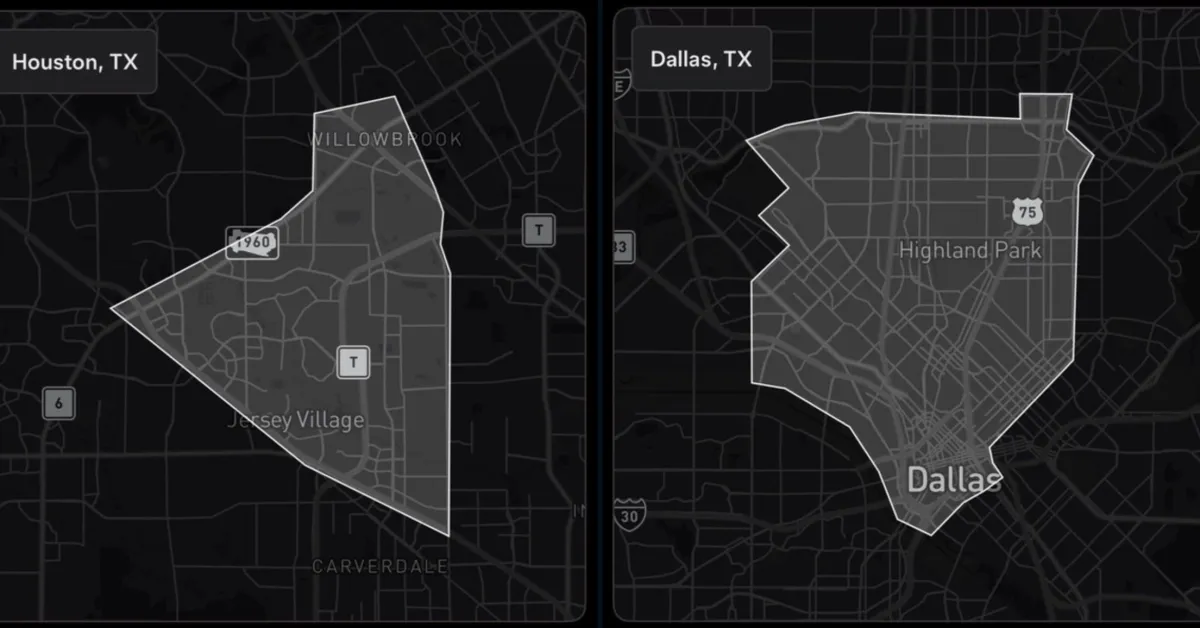
- The service areas are relatively small, with Houston covering 25 square miles and Dallas centering around Highland Park, while critics highlight safety concerns.
- In contrast to Tesla, Waymo operates fully autonomous robotaxis in the same Texas cities at a significantly larger scale.
Tesla Launches Robotaxi Service in Texas
Tesla has officially launched its “Robotaxi” service in Dallas and Houston, expanding beyond its previous operations in Austin and San Francisco. This rollout marks a significant step for the company, although the new service areas are smaller than its existing one in Austin.
The geofence for Houston spans about 25 square miles, while the Dallas zone is primarily located in Highland Park. Tesla’s Austin geofence, by comparison, has expanded to approximately 245 square miles since its initial launch nearly a year ago. Much of this expansion took time, starting from just a 20-square-mile area.
Details regarding the operational specifics of the new service remain unclear. Tesla’s account on X (formerly Twitter) posted the announcement without providing information about the size of the fleet, whether rides will have human supervisors, or the pricing structure.
Current insights reveal that Tesla’s operations in Austin still depend heavily on vehicles with safety monitors, as only a small fraction—between 4 and 12 Model Ys—are being utilized without supervision. These are part of a larger fleet of about 80 vehicles, while Tesla staff oversees operations remotely. This situation raises questions about the viability of its new service in Texas, considering the historical challenges faced by the company in meeting ambitious autonomy goals.
Elon Musk had previously projected the rollout of 1 million robotaxis by 2020. However, this has not come to fruition; Tesla currently operates far fewer vehicles than planned in both Austin and the Bay Area. Critics point out that Tesla’s safety metrics are concerning, with incidents reported to the National Highway Traffic Safety Administration (NHTSA) indicating a crash rate significantly higher than that of human drivers.
As Tesla expands its service into Dallas and Houston, safety concerns remain prominent. Reports indicate numerous crash incidents linked to the Austin operation, and incidents in other municipalities reflect a similar trend. Notably, Tesla maintains a degree of confidentiality regarding crash narratives in its NHTSA filings, contrasting sharply with competitors like Waymo, which provide more comprehensive incident descriptions.
Waymo, meanwhile, has been operational in both Houston and Dallas since February 2026, deploying fully driverless vehicles without human oversight. They have achieved a remarkable scale, currently delivering 500,000 paid robotaxi rides each week across 10 cities and aiming for 1 million rides per week by the end of this year. Independent research suggests that Waymo’s autonomous vehicles significantly reduce the rate of serious-injury crashes compared to traditional drivers.
Tesla’s entry into the Texas market stands in stark contrast to Waymo’s established operation. While Tesla’s small rollout hints at an uncertain future, the company faces increased scrutiny regarding crash rates and operational transparency. Observers are keenly watching to determine the fleet size that Tesla can realistically deploy in these new markets, as well as the safety and operational metrics that accompany this expansion. Until clearer data is provided, Tesla’s latest launch risks being perceived as more of a marketing stunt than a substantive achievement in the realm of autonomous transportation.
The content above is a summary. For more details, see the source article.









