


Key Takeaways
- High-potential testing is crucial in EV platforms to ensure safety and reliability of components.
- High-voltage reed relays are recommended for safety and switching functions in hipot testing due to their low leakage and robust performance.
- Proper selection and design of relay systems can significantly enhance test efficiency and safety in electric vehicle testing environments.
Importance of High-Potential Testing in EVs
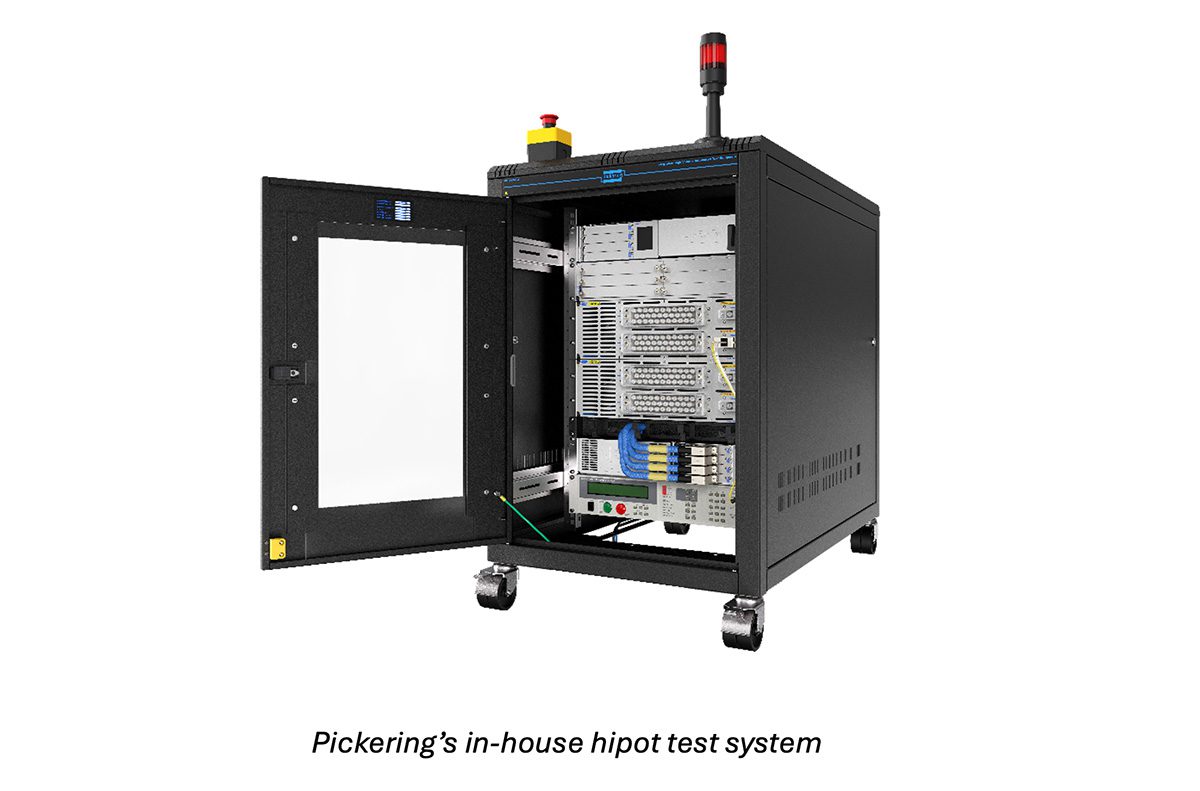
Electric vehicle (EV) platforms operate under high voltage and power, necessitating rigorous safety measures. High-potential (hipot) testing plays a pivotal role in assuring component safety and insulation integrity. This testing encompasses withstand and breakdown tests, where products undergo voltage stress above normal operating levels, measuring leakage to set safety margins. Accurate kilovolt power sources and low-leakage measurements are vital for this process.
A reliable hipot testing station includes essential components such as battery modules, traction inverters, onboard chargers, and high-voltage wiring harnesses—each demanding specific tests to confirm isolation and performance under various conditions. The effectiveness of these tests is contingent on the capabilities of the hipot station, which must apply and measure at kilovolt levels, manage fault energy, and ensure trustworthy leakage measurements.
Choosing the Right Switch Technology
In a typical hipot testing rig, a high-voltage source teams up with measurement hardware and a variety of switches that route the power to the device under test. These switches must endure high voltages and minimize leakage and parasitic capacitance while ensuring rapid, repeatable operation.
While electromechanical relays (EMRs) are economical, their open contacts limit the maximum switching capabilities. Solid-state relays, although faster, can introduce non-linear leakage. High-voltage reed relays, however, emerge as a robust solution. They provide exceptionally low leakage due to their sealed contacts and isolation for control electronics. Their rapid operation—typically under a millisecond—helps in maintaining high testing throughput.
A comparative analysis shows that traditional EMRs and solid-state relays experience higher leakage currents at elevated voltages, whereas reed relays maintain significantly lower leakage, thereby ensuring accurate test results.
Configuring a Hypot Testing Stage
An effective EV hipot station design incorporates various relay-controlled paths for different functions such as source routing, measurement, discharge, and protection. Reed relays play a critical role in facilitating safe and efficient testing processes by isolating high-voltage paths and providing accurate measurements.
With the ability to pack multiple channels onto a compact board thanks to their small size, reed relays enable the flexibility to meet a variety of testing demands.
Key Considerations for Relay Selection
When selecting relays for hipot testing, it’s essential to consider:
– Standoff voltage, ensuring that relays can safely withstand intended operational levels.
– Maximum switching voltage and power capability to handle breakdown tests.
– Isolation between switch and coil to protect control systems.
– High insulation resistance for precise leakage measurements.
A practical approach to selecting the right devices includes options like Series 63 and Series 600 for isolation needs, Series 60 and 65 for compact high-voltage routing, and Series 67 and 68 for high-power applications.
Final Thoughts on Testing Efficiency
Efficiency in EV testing hinges not just on voltage levels but also on throughput—rapid cycle times are essential. Reed relays, with their fast operation and high durability, significantly reduce maintenance needs while ensuring accuracy in testing. When standardizing relay families across platforms, engineers can simplify spare parts management and documentation, enhancing operational efficiency.
For building effective EV hipot solutions, it is recommended to use a combination of Series 63 or Series 600 devices for isolation, Series 104 for measurement, and Series 67 or 68 for discharge control, ensuring comprehensive and efficient testing capabilities.
The content above is a summary. For more details, see the source article.









