


Key Takeaways
- Proximity sensors and gesture detection enable touchless human-machine interaction in IoT systems.
- These technologies enhance convenience and hygiene across various applications, from smart homes to healthcare.
- Future advancements promise more accurate and immersive user experiences through AI and emerging sensing technologies.
Transforming Human-Machine Interaction
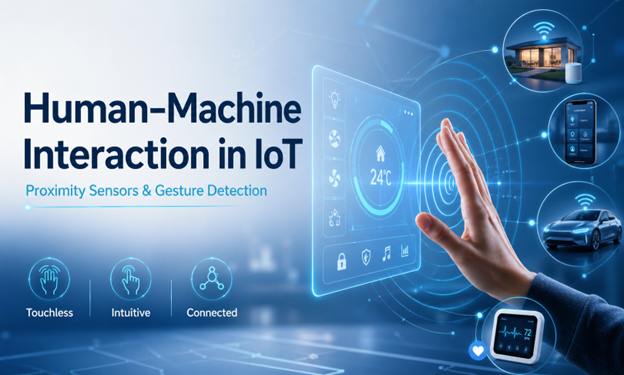
The Internet of Things (IoT) is fundamentally changing interactions with devices, emphasizing seamless human-machine interaction (HMI). This shift is achieved through technologies like proximity sensors and gesture detection, allowing users to engage with machines without physical contact.
Understanding HMI in IoT involves recognizing how interconnected devices facilitate easier communication. Traditional methods requiring buttons or touchscreens are being replaced by systems that intuitively respond to human presence. For instance, lights can turn on as someone enters a room, eliminating the need for manual switches.
Proximity Sensors Explained
Proximity sensors detect objects or people without requiring direct contact, employing various technologies such as infrared, ultrasonic waves, and electromagnetic fields. These sensors are categorized as follows:
- Infrared Sensors: Detect heat or light reflections.
- Ultrasonic Sensors: Use sound waves for measuring distances.
- Capacitive Sensors: Sense changes in electrical fields.
- Inductive Sensors: Identify metallic objects.
These sensors are integral to the development of responsive environments, making devices context-aware and energy-efficient. In smart homes, for example, lights can automatically activate when someone is present, while smartphones can prevent unwanted screen touches during calls.
Gesture Detection Technology
While proximity sensors recognize presence, gesture detection extends capabilities by interpreting human movement. Recognizing gestures—such as waving or pointing—this technology uses a mix of sensors and algorithms, allowing users to control devices with motions, eliminating the need for touch.
Applications of gesture detection span multiple industries. In smart TVs, viewers can navigate menus using hand movements. The automotive sector benefits through safer driving, enabling hands-free control of devices. In healthcare, gesture detection aids surgeons in interacting with medical imaging systems without compromising sterility during procedures.
Integration of Technologies
The combination of proximity sensors and gesture detection represents the full potential of IoT. For example, in a smart kitchen, a proximity sensor can activate a display when an individual approaches, allowing interactions via gestures. This synergy offers touchless, intuitive user experiences also seen in smart retail environments, fostering customer engagement through interactive displays.
Benefits of Touchless Interaction
The adoption of these technologies provides numerous advantages:
- Hygiene: Minimizes physical contact, crucial in medical and public settings.
- Convenience: Facilitates quicker and more intuitive interactions.
- Accessibility: Empowers individuals with disabilities to engage more easily with devices.
- Efficiency: Automates responses, enhancing time and energy savings.
These benefits speak to the growing preference for touchless technology in modern IoT applications.
Challenges Facing These Technologies
Nonetheless, challenges persist. Gesture detection may struggle to interpret movements accurately in complex environments or poor lighting. Proximity sensors might face limitations in range or materials they can detect. Additionally, privacy concerns around tracking user movements underscore the need for data security to build user trust.
Future Trends in HMI
The future of HMI in IoT appears promising, with advancements in AI and machine learning enhancing sensor capabilities to better understand user intent and behaviors. Upcoming innovations could introduce immersive touchless interfaces integrated with augmented and virtual reality, allowing interaction with digital objects in physical spaces. Furthermore, radar-based technologies may enable precise control over compact devices.
In summary, the evolution of human-machine interaction in IoT is driven by the demand for more natural communication methods. Proximity sensors and gesture detection are essential in this transition, enriching daily experiences across various sectors. As developments continue, the focus on user-friendly systems will be paramount in creating a more interconnected world.
The content above is a summary. For more details, see the source article.









