


Key Takeaways
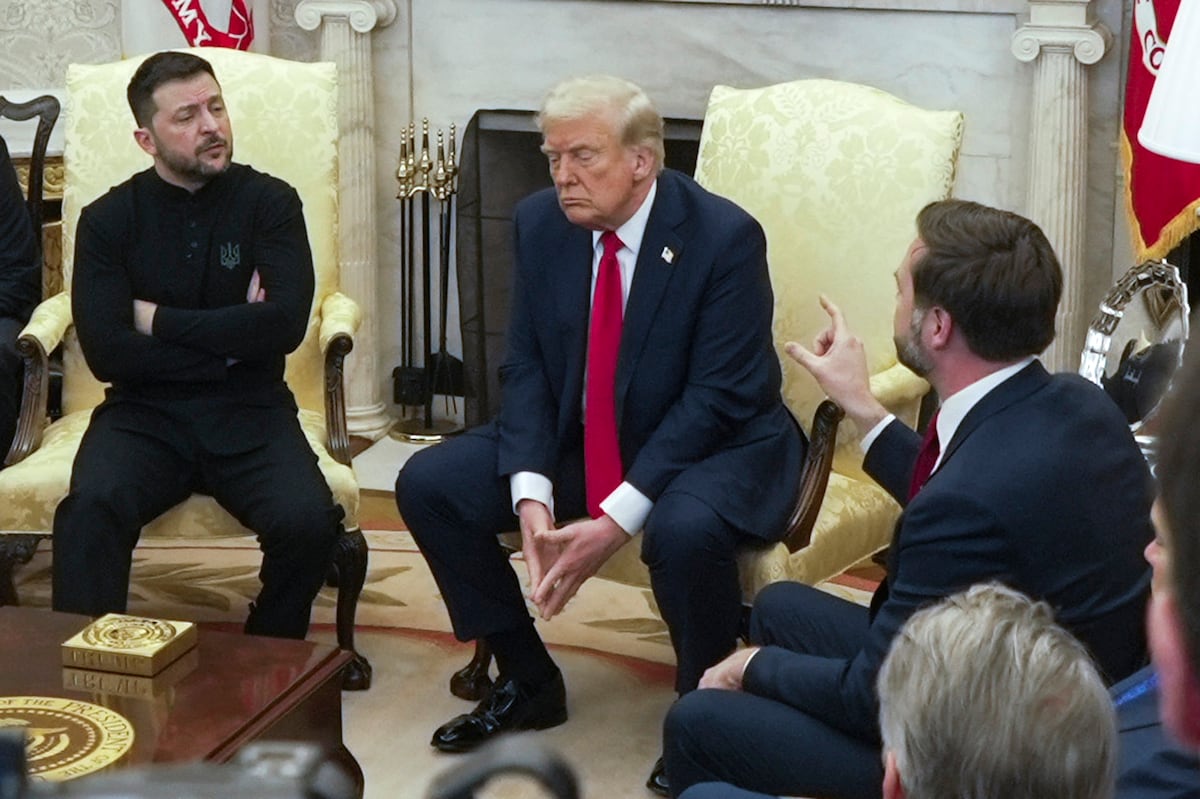
- President Trump and Vice President Vance criticized Ukrainian President Zelenskyy during an Oval Office meeting, questioning his commitment to peace.
- The Pentagon reports dwindling funds for military support to Ukraine, raising concerns about future U.S. aid amid shifting political dynamics.
- Zelenskyy warned that neglecting Ukraine could lead to broader consequences for U.S. security against Russian aggression.
Tense Meeting Between U.S. and Ukraine Leadership
Support for Ukraine appeared to be at a critical juncture following a tense meeting between President Donald Trump, Vice President JD Vance, and Ukrainian President Volodymyr Zelenskyy. The Oval Office discussion escalated from cordial to contentious, as Trump and Vance accused Zelenskyy of not actively seeking an end to the conflict with Russia. Trump asserted that Zelenskyy believes U.S. involvement gives him a negotiation advantage, stating, “I don’t want advantage, I want peace.”
As concerns mounted surrounding U.S. military and humanitarian assistance to Ukraine—which has totaled nearly $70 billion over the past three years—White House officials were not immediately clear on the future of this support. The Pentagon indicated that it lacks funds to replace the military equipment sent to Ukraine, and Congressional backing for ongoing assistance seems uncertain.
Zelenskyy was in Washington to finalize an agreement granting American access to Ukraine’s rare earth minerals in exchange for economic and security aid amid the ongoing war. This negotiation forms part of Kyiv’s efforts to maintain U.S. support, particularly as diplomatic relations between Washington and Moscow seem to be shifting.
The Trump administration’s approach to European security has been pointed, with Defense Secretary Pete Hegseth urging European nations to take greater responsibility for their defense. In a later conference, Vance reiterated this stance by indicating that U.S. military commitments in Europe would be reduced in favor of focusing on more critical global regions.
During the Oval Office meeting, tensions peaked when Vance confronted Zelenskyy regarding his conduct, suggesting it was disrespectful to engage the American media on such matters. Trump echoed these sentiments, expressing frustration that Zelenskyy was “gambling with the lives of millions of people” and the potential of escalating global conflict.
In the weeks leading up to the meeting, Trump had escalated his rhetoric against Zelenskyy, labeling him a “dictator” and implying that he had provoked the war with Russia. Meanwhile, Zelenskyy emphasized the broader implications of failing to support Ukraine, warning that the U.S. would eventually feel the repercussions of Russian aggression, stating, “You have a nice ocean and don’t feel it now… but you will feel it in the future.”
Despite the heated exchange, Zelenskyy was expected to sign an economic agreement aimed at financing the reconstruction of war-damaged Ukraine. This deal, viewed as crucial for intertwining the futures of both nations, was set to emphasize the importance of Ukraine’s security. Trump noted earlier in the meeting that the agreement was on track for completion, but the heated atmosphere cast uncertainty over the meeting’s outcomes.
The urgency of this meeting was underscored by the visits of leaders from Britain and France earlier in the week, who lobbied for the continued support of the U.S. for Ukraine and European security overall. The combined pressure illustrates the high-stakes context in which Ukraine currently navigates its relations with the United States, amidst fears of geopolitical fallout as the three-year conflict continues.
The content above is a summary. For more details, see the source article.









