

Key Takeaways
- The White House has issued an executive order to boost domestic mineral production, particularly potash, which the U.S. imports over 90% of.
- The Defense Production Act will be employed to facilitate the expansion of domestic production and expedite permitting for mining projects.
- Industry analysts suggest focusing more on phosphate rather than potash for long-term fertilizer security due to risks associated with current global supply chains.
Executive Order to Enhance Mineral Production
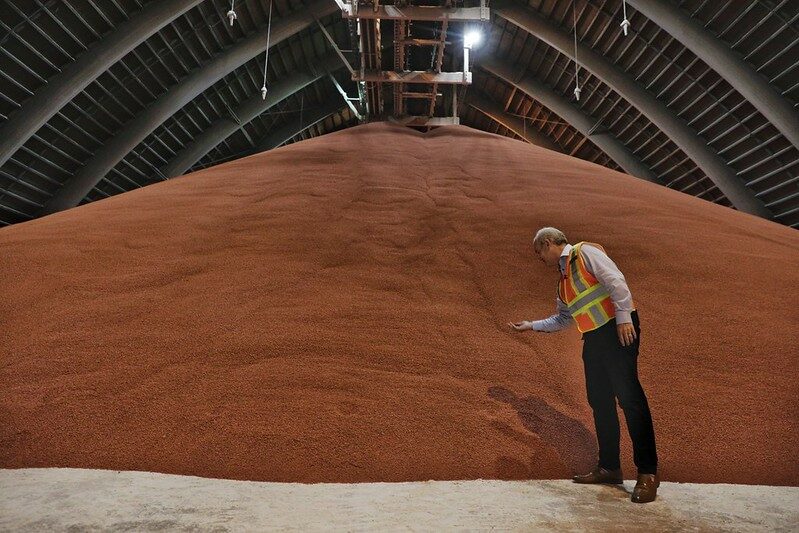
The White House has taken a significant step to strengthen domestic production of critical minerals, especially potash, through a new executive order. Issued on Thursday, the order mandates federal departments to collaborate with the newly established National Energy Dominance Council, led by Interior Secretary Doug Burgum. The focus will be on identifying mining projects for expedited permitting, soliciting industry feedback, and prioritizing suitable federal land sites for mining operations.
Currently, the U.S. is heavily reliant on imports for its potash needs, sourcing more than 90% of it from foreign suppliers, primarily Canada. Ed Thomas from The Fertilizer Institute highlighted that cumbersome permitting processes hinder the growth of the domestic industry, assuring that the executive order could streamline these procedures and facilitate faster project approvals.
A notable project awaiting permits is a $1.2 billion salt and potash mining facility in Michigan’s Osceola County, which covers a 302-acre area. Beyond Michigan, analysts point to reserves in New Mexico and South Dakota that could be developed to further augment domestic potash production.
Concerns over supply chain vulnerability have intensified due to recent strikes affecting Canadian port and rail operations, which provide over 80% of U.S. potash imports. Thomas emphasized that such disruptions can coincide with critical planting seasons, creating supply shocks that could jeopardize U.S. food production. Given that major global potash producers include adversarial nations like Russia, which controls nearly 20% of production, the need for resilient domestic sources becomes even clearer.
Moreover, Thomas advocates for the U.S. Geological Survey (USGS) to reclassify potash as a critical mineral, enhancing its funding and permitting processes. While potash was designated as a critical mineral in 2018 during the Trump administration, it was not included in the 2022 report.
However, some industry voices, like Josh Linville from StoneX, contend that the focus should shift toward phosphate rather than potash for strengthening the domestic fertilizer supply. Linville argues that the U.S. faces a greater risk of overproduction of potash, considering that Canada’s abundant resources produce more than 21 million tons annually. He noted that global supplies are already sufficient, with multiple new projects expected to commence.
In contrast, Linville pointed out that nitrogen and phosphate fertilizers face more constraints. The U.S. has considerable domestic phosphate reserves, particularly in Florida and North Carolina, but expansion has been limited by environmental concerns. While the U.S. predominantly utilizes domestic phosphate, China plays a significant role in the global market, supplying approximately half of the world’s phosphate production.
Furthermore, Linville highlighted that increasing domestic phosphate production not only ensures long-term supply security but also presents significant cost savings for farmers, as current phosphate prices are elevated compared to historical averages. He suggested that expanding mining operations and research into the phosphate sector should be prioritized over potash.
In summary, while the executive order aims to bolster domestic mineral production, the discourse within the industry leans towards a more strategic approach, evaluating the broader implications for U.S. food supply and agricultural economics in relation to both potash and phosphate.
The content above is a summary. For more details, see the source article.