Key Takeaways
- The Deuteronilus Cavus crater holds 4 billion years of Martian geological history, shaped by various activities.
- Key features include channels formed by water flow and glacial debris, indicating past ice presence.
- The Mars Express mission continues to unveil Mars’s complex landscape and geological processes.
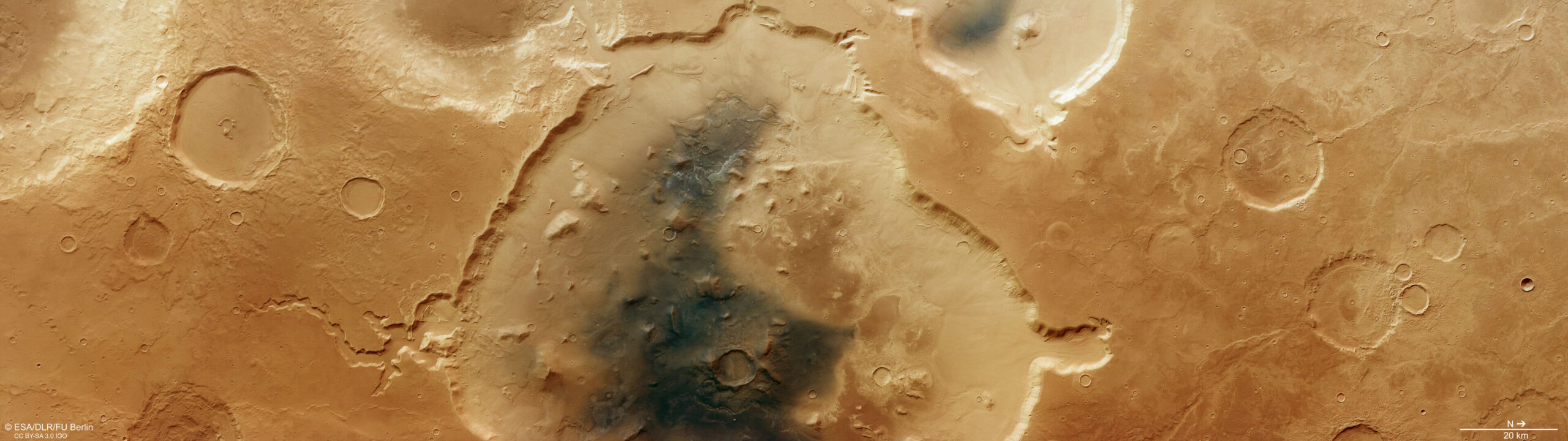
The European Space Agency’s Mars Express has captured breathtaking images of the Deuteronilus Cavus crater, a roughly 120 km-wide formation situated between Mars’s rugged southern highlands and flatter northern lowlands. This crater, rich in ice and elements of Martian history, has been formed over billions of years, showcasing its origins as an impact crater likely created by asteroid or comet collisions around 4.1 to 3.7 billion years ago. Over time, erosion from water and ice has expanded the original crater nearly twofold.
Distinctive channels, visible on the crater rim, may have been forged by flowing water or by subsurface draining, which caused the overlying surface to collapse. These channels exhibit grooved textures that indicate the former presence of ice. The smooth, tongue-shaped ends at the base of the crater’s walls represent rock-covered glaciers formed during periods of glaciation. Such glaciers likely emerged while Mars had a different axial tilt, further contributing to the crater’s unique features.
The crater interior presents a diverse landscape filled with rocky formations, which resemble a ‘rocky road’ refrigerator cake. These rugged blocks (knobs and mesas) have resisted wind, water, or ice erosion, suggesting they may be remnants of a larger, collapsed rock peak that once occupied the center of the crater. Beyond the jumbled formations lies a dark deposit thought to be volcanic ash, interspersed with lighter clay mineral deposits, hinting at ancient liquid water presence.
Additionally, the surrounding terrain is marked by ‘wrinkle ridges’ formed as lava flows cooled and contracted. The multitude of features within Deuteronilus Cavus provides a valuable opportunity to study the geological and climatic history of Mars. Since its launch, the Mars Express has substantially enhanced our understanding of the Martian landscape and the processes that have shaped it.
This remarkable observation also highlights the ongoing importance of Mars research, with future studies potentially revealing even more about the planet’s storied geological timeline.
The content above is a summary. For more details, see the source article.