


Key Takeaways
- The Army is discontinuing its dedicated drone battalion experiment less than a year after initiating it.
- This decision follows extensive evaluations during Exercise Saber Junction and aligns with strategic shifts outlined in “The Army Azimuth.”
- The Pentagon continues to emphasize enhancing drone capabilities across its military operations.
Drone Battalion Experiment Concludes
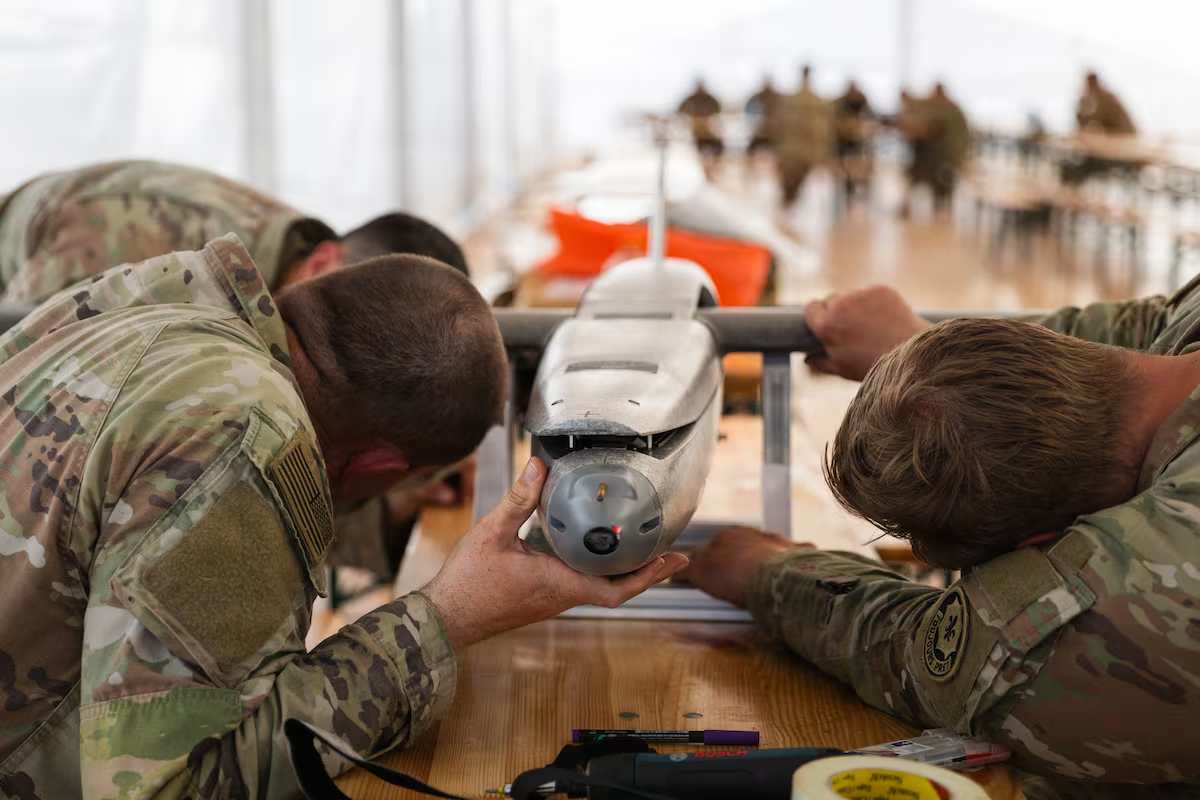
The U.S. Army has decided to end its dedicated drone battalion experiment, just months after its launch in November 2025. The initiative was a collaboration between U.S. Army Europe and Africa and aimed at integrating lessons learned from existing drone operations, particularly those observed in Ukraine. An Army official confirmed that the battalion would revert to its traditional airborne infantry duties following its participation in the multinational Exercise Saber Junction, which occurred over the past summer.
Details regarding the specific unit or the number of personnel involved were not disclosed. The decision to conclude the experiment was first reported by the Wall Street Journal. This move is part of broader strategic objectives outlined by Acting Chief of Staff of the Army, Gen. Christopher LaNeve. In his recently released roadmap, “The Army Azimuth,” LaNeve emphasized the importance of enhancing the Army’s capabilities to counter adversaries utilizing stand-off weapons, including unmanned systems and weapons of mass destruction (WMD).
The emphasis on soldier readiness and tactical skills indicates a return to fundamental military training amidst the evolving landscape of modern warfare. The need for U.S. forces to be well-versed in the core principles of soldiering remains a priority, as articulated by LaNeve in his public statements.
Acceleration in drone development and deployment continues at the Pentagon, largely in response to a June 2025 executive order that mandated a boost in unmanned aerial systems capabilities. Following this directive, Defense Secretary Pete Hegseth issued a memorandum in July, admitting that current U.S. military units are not adequately equipped with the advanced small drones essential for contemporary battlefields. To address these gaps, the Pentagon pledged to enhance its procurement and fielding strategies for military drones.
Further amplifying these efforts, U.S. Central Command (CENTCOM) recently announced the formation of a multinational task force intended for operations with one-way attack drones—expanding their use to aerial and underwater environments in collaboration with regional allies. This development follows the establishment of Task Force Scorpion Strike in 2025, which is based in the Middle East and is similarly outfitted for one-way drone operations.
In the context of evolving military strategies and the increasing reliance on advanced technology, the Army’s swift reassessment of its drone battalion reflects a commitment to adaptability and an emphasis on foundational soldier skills. The landscape of military engagement continues to be shaped by the integration of innovative systems, underscoring the importance of responsiveness to both doctrinal changes and battlefield realities.
The content above is a summary. For more details, see the source article.









