


Key Takeaways
- The Marine Corps unveiled its new Medium Landing Ship (LSM), designed to transport troops and supplies without needing established ports.
- Based on the Damen Shipyards Group’s LST-100 design, the LSM can carry over 800 tons of cargo and navigate a range of 3,400 nautical miles.
- This new vessel aims to enhance operational flexibility amid readiness challenges in the Navy’s amphibious fleet and counter threats in the Indo-Pacific region.
New Medium Landing Ship Enhances Marine Corps Capabilities
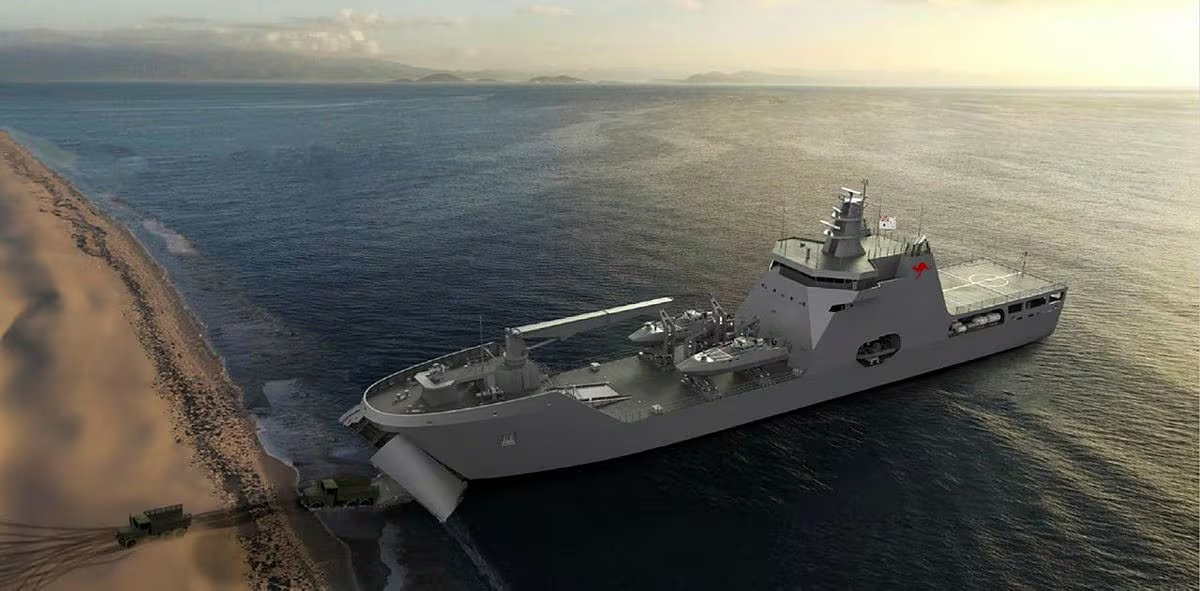
The U.S. Marine Corps recently released a video detailing the design and capabilities of its new Medium Landing Ship (LSM). This innovative vessel is engineered to transport troops, equipment, and supplies to shorelines without depending on established ports. According to the video, the LSM is based on the Damen Shipyards Group’s Landing Ship Transport 100 (LST-100) design. This ship can cover a range of approximately 3,400 nautical miles and has the unique capability to beach itself, allowing it to deliver over 800 tons of cargo, including vehicles and long-range fire assets.
Measuring about 100 meters in length, the ship features a flight deck that supports operations with unmanned aerial systems. The Marine Corps envisions the McClung-class ship as a supplemental resource within the broader fleet, especially useful for operations across island chains or contested coastal regions, where smaller vessels have advantages over larger battleships. The Marine Corps emphasizes that the LST-100 is not a traditional amphibious warfare ship designed for large-scale assaults; rather, it serves as a complementary asset that enhances intratheater logistics, allowing the larger amphibious fleet to perform effectively.
The introduction of the LSM aligns with the Navy’s current challenges related to fleet readiness. A 2025 report indicated that readiness rates had dipped below essential levels due to maintenance delays and subpar ship conditions, resulting in fewer ships being fit for duty. The video pointed out escalating tensions and competition in the Indo-Pacific region, where the U.S. is increasingly focused on countering China’s growing military presence. The LSM will be pivotal for establishing a forward presence by effectively getting troops, weapons, and supplies ashore, all critical to a comprehensive “sea denial strategy.” This strategy aims to control vital terrain and disrupt adversarial maritime operations from land bases.
In December 2025, Navy leaders approved the ship’s design as part of a broader initiative to modernize the Navy’s fleet. The LSM supports the “Golden Fleet” initiative, a concept introduced during the Trump administration that highlights the need for large “Trump-class” battleships. However, this idea has faced skepticism; some Chinese analysts have labeled these proposed battleships as potentially more vulnerable to anti-ship weapons. Moreover, a recent analysis by the Center for Strategic and International Studies raised questions about the feasibility of such battleships, citing concerns regarding costs and lengthy development timelines.
Eve Sampson, a former Army officer and seasoned reporter, has covered military conflicts globally and has contributed to leading publications like The New York Times, The Washington Post, and The Associated Press.
The content above is a summary. For more details, see the source article.









